Your Invisalign Questions Answered
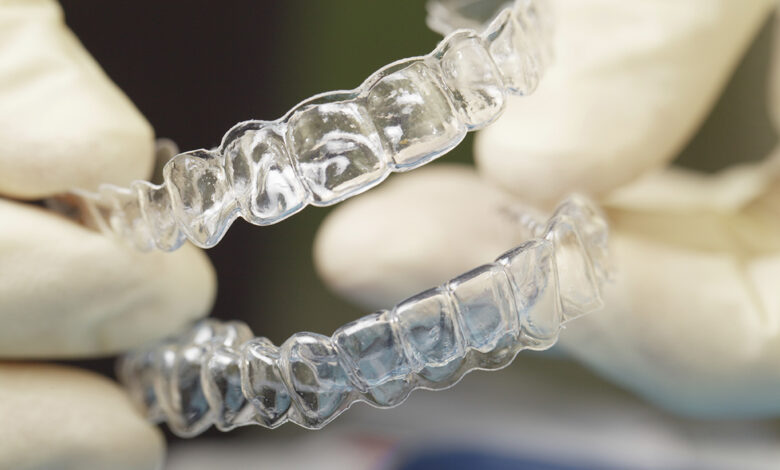
Priya keeps a running tally of the questions readers email about Invisalign. These are the ones that come up over and over — answered honestly, including the ones marketing material tends to fudge.
The basics
How long does treatment actually take?
Cosmetic-only (“Express”) cases: 4–8 months. Mild-to-moderate adult cases: 9–14 months. Complex bite work: 18–24 months. Compliance matters massively — wearing trays only at night will roughly double your treatment time and produce a worse result.
Does it hurt?
Discomfort, not pain. The first 2–3 days of each new tray feel pressured and tender — that’s the active movement phase. Paracetamol if needed. Most people stop noticing by month 2.
Can I really not eat with them in?
You can drink water. Anything else — coffee, tea, soft drinks, alcohol, food — comes out. The trays warp from heat and stain quickly. Plan your day around fewer, longer eating windows rather than constant grazing.
What about kissing / dating / etc.?
Trays in is fine — most people don’t notice them. The bigger issue is the 20–22 hour daily wear commitment, which means trays in during dinner dates is the realistic norm. Plan accordingly.
Cost and value
How much does it really cost?
In Sydney 2026: $3,500–$5,500 for cosmetic-only “Express” cases, $6,500–$9,500 for comprehensive cases, $9,500–$12,000 for complex cases with significant bite work. Most clinics offer monthly payment plans.
Will my health fund cover any of it?
Health funds with orthodontic extras typically rebate $800–$1,500 per calendar year, subject to your annual orthodontic limit. Some funds have lifetime ortho limits. Ask the fund directly with the Invisalign item code your dentist supplies.
Is it worth it vs traditional braces?
Cost is roughly equivalent. Treatment time is roughly equivalent. Aesthetics — Invisalign wins. Hygiene — Invisalign wins. Severe cases — braces still have an edge for major skeletal corrections. Compliance — braces win because they’re glued on.
The “is this even right for me” questions
I’m 45 — is it too late?
No. Adult Invisalign is the fastest-growing patient segment. As long as your gums are healthy and your existing restorations can handle it, age is not a factor.
I have crowns / veneers / implants — can I still do Invisalign?
Usually yes, but with planning. Implants don’t move (they’re osseointegrated), so the plan has to design around them. Crowns and veneers move with the underlying tooth but attachment placement may need to be different. A scan and ClinCheck will tell your provider what’s possible.
What if I just want my front teeth straight?
“Express” or “Lite” Invisalign packages handle exactly this. 6–8 months, 14–20 trays, $3,500–$5,500. The trade-off: bite isn’t usually addressed in a cosmetic-only package — so this is for people who already have a functional bite and just want cosmetic alignment.
The practical day-to-day
How do I clean them?
Rinse under cool water after meals. Brush with a soft toothbrush and clear unscented soap once a day. Don’t use toothpaste (abrasive) or hot water (warps). Invisalign-branded cleaning crystals are fine; supermarket denture tablets are a cheap alternative.
What if I lose a tray?
Don’t panic. If you’re more than halfway through wearing it, move to the next tray. If you’re early in the cycle, go back to the previous tray and call your provider for a replacement.
What if I miss a day or a week?
One day is fine. A few days, you may need to go back to a previous tray for a few days before returning to your current. A week or more, ring your provider — you may need a refinement scan.
Will my speech be affected?
A slight lisp for the first week, then your tongue adapts. Reading aloud helps speed this up. By week 2, most people sound normal again.
The end-of-treatment questions
Will I really need to wear retainers forever?
Effectively yes. Teeth want to drift back. Full-time for 3 months after the active phase, then nights-only indefinitely. Most patients tolerate nightly retainers easily; the alternative is paying for a second course of Invisalign in your 50s.
What happens to the attachments?
Removed at the final visit. Polished off the teeth, no permanent change.